Optimizing Daylighting: Exploring Visual and Non-Visual Effects through Weather, Orientation, and Location
Liliana O. Beltrán and Luming Xiao · Texas A&M University
Research Assistant · Summer 2021–Fall 2023 · PLEA 2024
If a desk receives enough daylight for reading, how much light reaches the eyes of someone sitting there? We tested window and shade designs for a south-facing office in 12 locations, from Quito to Anchorage, to see how the answer changes with local skies, season, and the direction a person faces.
Daylight on the desk and at the eye
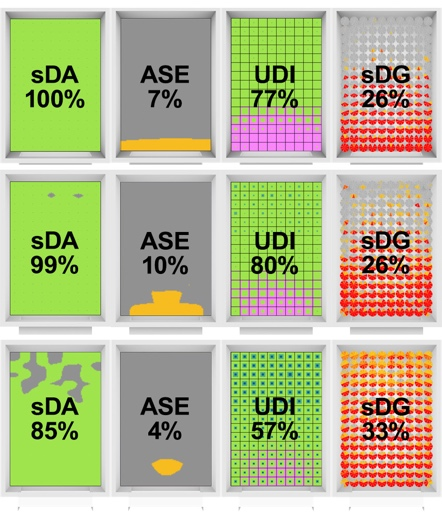
We kept the office 9.1 m deep, with windows along one wall. In each location we varied the window size, glazing transmittance, and exterior shades. ClimateStudio simulations tracked daylight, direct sun, and glare over the year. For selected designs, we used Lark to calculate equivalent melanopic lux (EML) at seated eye height, looking in eight directions at each of 150 positions at noon on the solstices and equinoxes.
The rows in both figures show Quito, Phoenix, and Anchorage, from top to bottom.
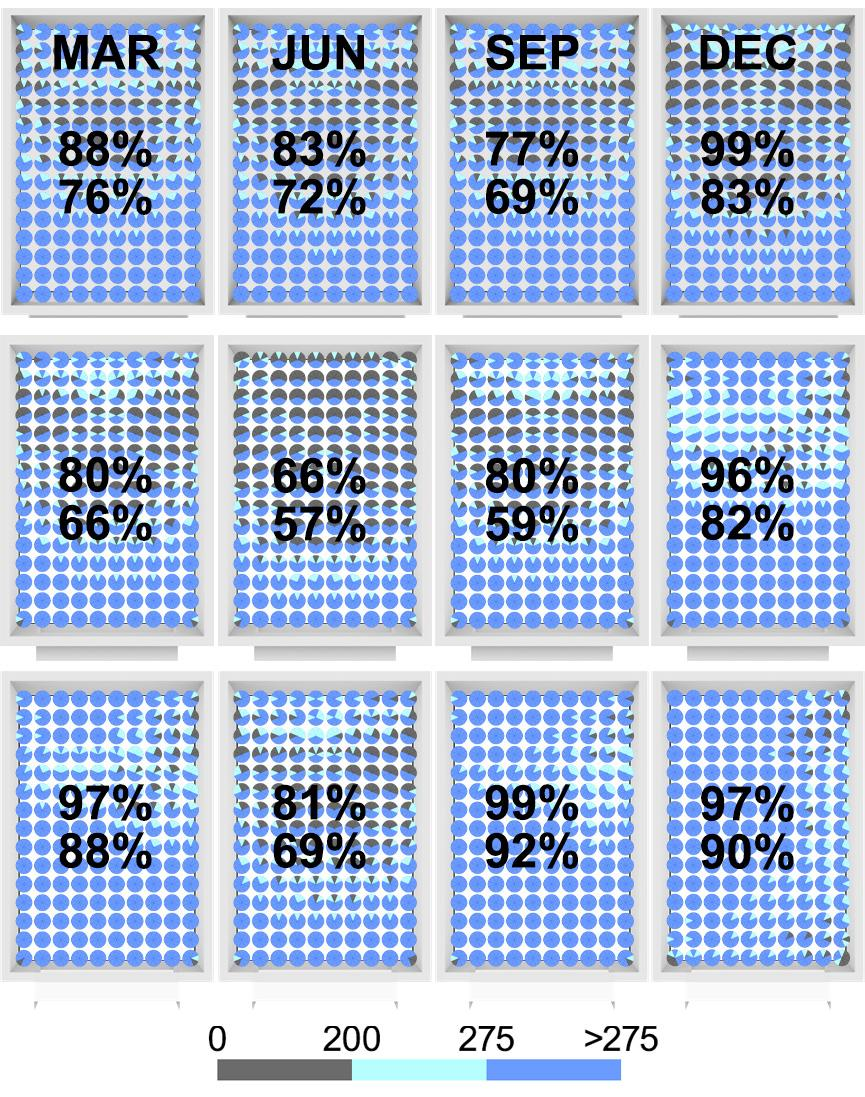
On the eye-level maps, each circle shows eight viewing directions. The two percentages give the share of floor area above 200 EML (upper value) and 275 EML (lower value).
What we found
- Local skies shaped the choice of shade. The simulations identified many more window and shade combinations that met the study’s daylight criteria in partly cloudy Quito than in sunnier Phoenix, where controlling direct sun narrowed the options.
- Viewing direction mattered even at the same desk. In the middle zone of the office, a person facing the windows could receive more than 275 EML. Turning toward the back wall could lower that value below 200 EML.
- The annual and seasonal results told different stories. In Phoenix, 99% of the floor area met the annual daylight autonomy criterion. At noon on the June solstice, only 57% of the area exceeded 275 EML at eye level, compared with 82% at noon on the December solstice.
Read the PLEA 2024 paper for the full 12-location comparison