Contrasting Spectral Sky Modeling Approaches with Field Spectrophotometric Measurements in Central Texas Under Clear, Partly Cloudy, and Overcast Skies
Luming Xiao and Liliana O. Beltrán · Texas A&M University
Independent research · Spring–Fall 2026 · ASES SOLAR 2026
How accurately do spectral sky models predict the visual and melanopic quantities derived from outdoor daylight spectra? We tested two spectral sky models against rooftop measurements in College Station, Texas, comparing photopic illuminance, equivalent melanopic lux (EML), and the ratio of EML to photopic illuminance (M/P).
What we compared
On the Langford A rooftop, we measured the spectrum of daylight on a horizontal plane and photographed the sky in high dynamic range. We sampled four conditions: clear, partly cloudy with the sun visible, partly cloudy with the sun blocked by clouds, and overcast.
Lark v3 used reference spectra selected by correlated color temperature (CCT), with direct and diffuse light levels derived from field measurements. ClimateStudio v2.4 used libRadtran atmospheric simulations with a clear or overcast preset. Both workflows used the same location, time, and receptor orientation as the measurements.
How quickly can daylight change?
On September 21, both observations fell under partly cloudy skies. When a cloud blocked the sun, photopic illuminance fell by 83% in five minutes and equivalent melanopic lux (EML) fell by 80%. Their ratio (M/P) rose from 1.016 to 1.206. The daylight was dimmer, but each photopic lux carried a greater melanopic contribution. A sky model must capture this shift in the spectrum as well as the drop in illuminance.
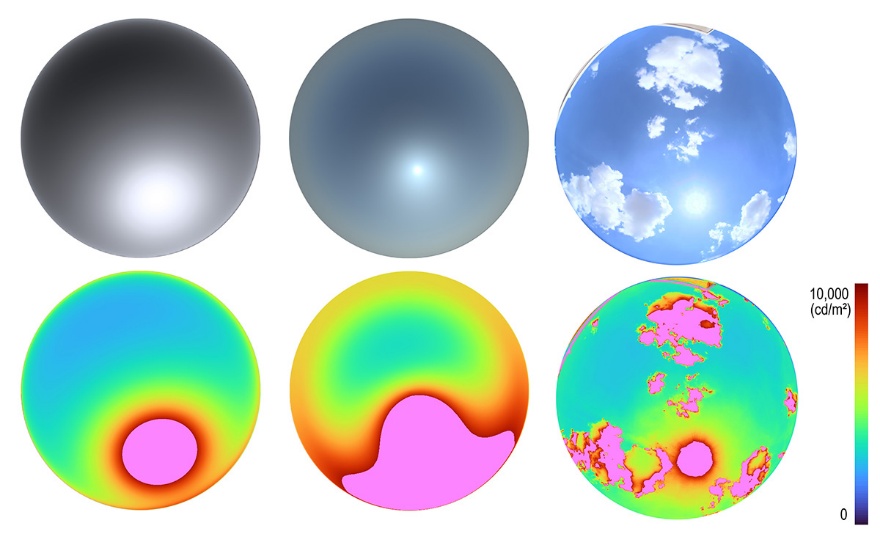
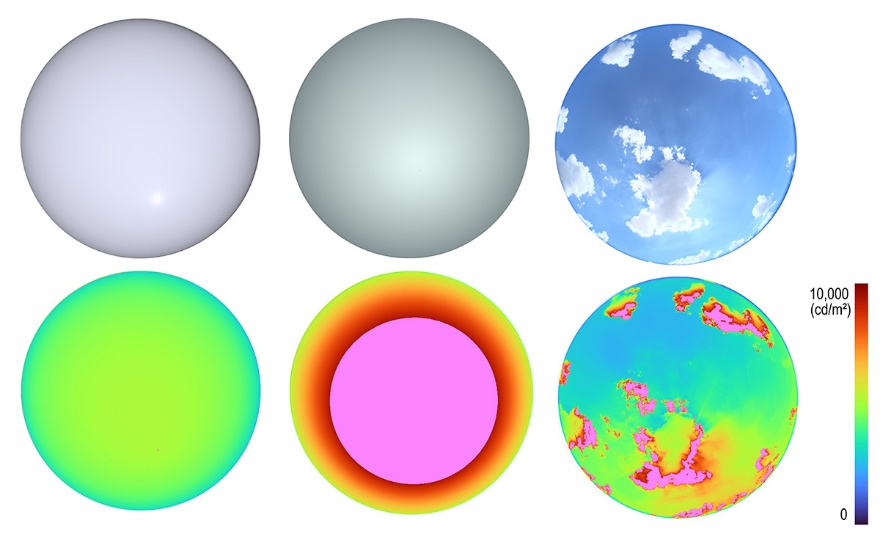
Each panel shows Lark, ClimateStudio, and the measured sky from left to right. The lower row maps sky luminance (cd/m²).
What we found
Across these four observations, ClimateStudio predicted photopic illuminance more closely under clear and overcast skies than when a cloud blocked the sun in a partly cloudy sky. In that sun-blocked case, Lark used measured illuminance as input and came within about 1% of the photopic reading, yet underestimated EML by 14%. For building simulations that depend on the daylight spectrum, partly cloudy sky models need to account for whether clouds block the sun.
Read the ASES SOLAR 2026 conference manuscriptConference poster